
What We Know

5. The Apex reduces overexertion injury risks.

Three converging lines of evidence indicate that the Apex 2 reduces work-related musculoskeletal disorder risks.

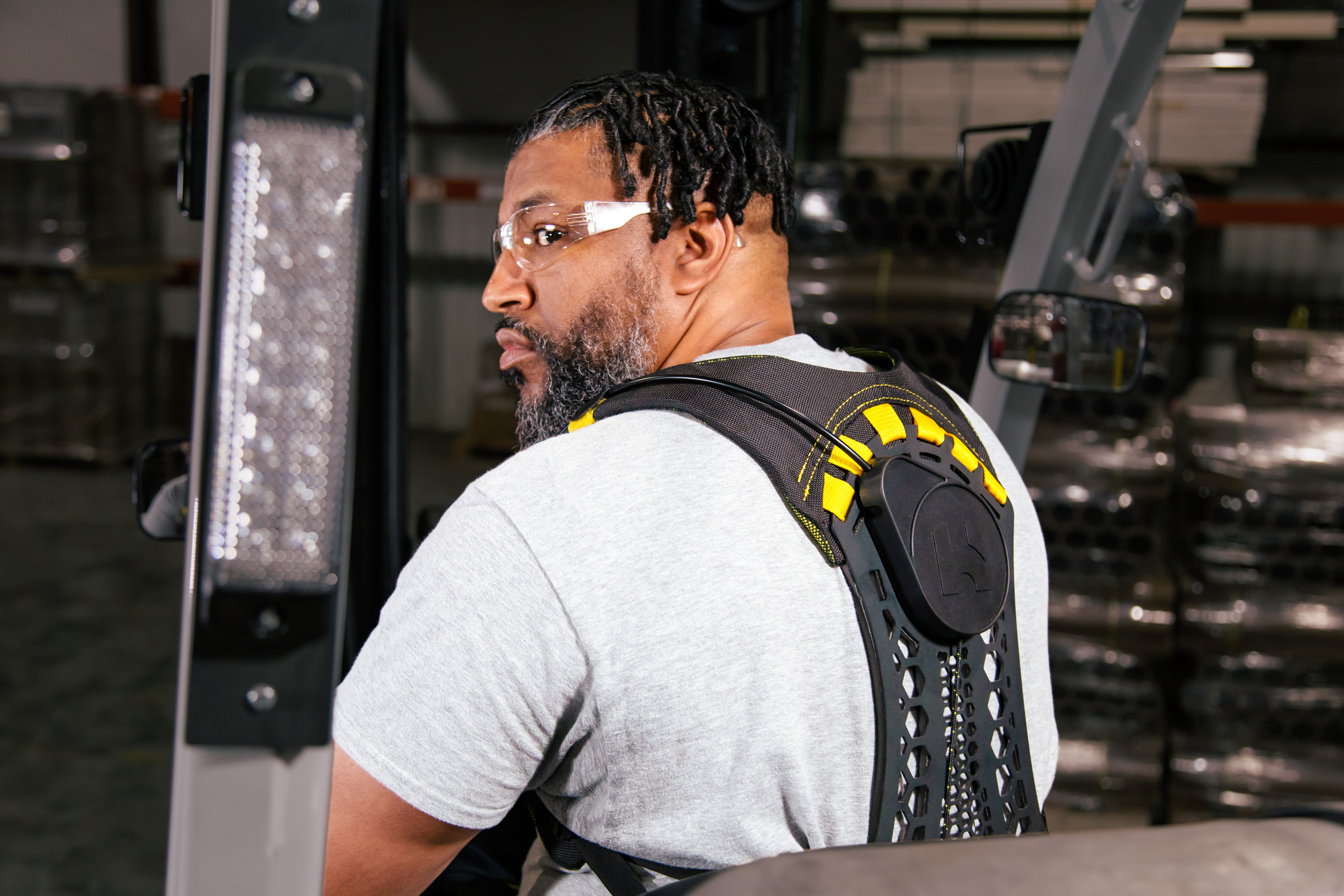
Longitudinal injury data: First, there is direct evidence from longitudinal field studies that the Apex reduces back injuries. During 2024, three HeroWear customers (including URM, a grocery distributor) deployed the Apex into their distribution centers and then tracked injuries during more than 281,000 hours of work. These case studies represent the equivalent of 140 workers working full time for a year and performing tens of millions of bend/lift cycles. Based on historical data, these companies expected 10.5 back injuries for these workers during the 281,000 hour period; however, they experienced zero back injuries among warehouse case pickers using the Apex. Read here for more details on this long-term injury reduction study.
Marvin_forklift_looking-back_202230215

Similar outcomes and trends have also been reported by HeroWear clients like Rust-Oleum and URM Foods—both of which reported that their back injuries dropped to zero after adopting Apex 2 exosuits and monitoring long-term injuries. In 2025, another aggregated data study across 4 client warehouses found that after deploying Apex 2s, the total sprain and strain injury rate dropped 67% through more than 302K hours of work after exosuit deployment. This dataset represented the equivalent to 151 full-time workers using the Apex 2 regularly for a year. Zero back injuries were reported during this period. These long-results indicated that the back injury rate went down without injuries to other body parts going up.

Ergonomic risk data: Second, ergonomic assessment tools have provided quantitative insight into how much injury risks are reduced by exosuits like the Apex that alleviate peak forces on the lower back. In one peer-reviewed material handling study done in collaboration between Vanderbilt and Auburn Universities, the Apex was estimated to reduce back injury incidence by 20–60% (Zelik 2022). Another peer-reviewed study done by Vanderbilt University and the U.S. Army found that individuals wearing an exosuit exhibited 34-89% lower cumulative back damage (an indicator of low back disorder risk) when wearing the exosuit during heavy repetitive lifting (Rodzak 2024). Multiple other third-party and peer-reviewed studies provide further corroborating evidence that the Apex reduces injury risk factors like peak lumbar moment, back muscle activity, and spine compression force. Read the science articles #1 Reduction of Muscle Strain and #2 Reduction in Spinal Compression Force to learn more.

Worker-reported data: Thirdly, extensive worker-reported survey data show that the Apex significantly reduces bodily discomfort. Discomfort is often a leading indicator of musculoskeletal disorder risk due to overexertion. See science article #4 Reduction of Discomfort to learn more.

Important distinction vs back belts: 

The injury reduction benefits of exosuits are one of the key aspects that distinguish them from back belts and back braces. Exosuits and back belts are two very different classes of devices—both functionally and biomechanically.

Back belts provide tactile feedback to remind people to lift with a neutral spine. But the scientific and safety communities have known for decades that back belts do not actually reduce the loading on a user’s back muscles (Majkowski 1976, Thomas 1999). Furthermore, in long-term prospective studies (e.g., Wassell 2000) and randomized controlled trials (e.g., Mireille 1998), using back belts did not lead to a reduction in low back injuries, low back pain incidence, sick leave, or medical claims. For the last 30 years, the National Institute for Occupational Safety and Health (NIOSH) has maintained the following recommendations and guidance (NIOSH 1996):
  • “There is a lack of scientific evidence that back belts work.”
  • “Although back belts are being bought and sold under the premise that they reduce the risk of back injury, there is insufficient scientific evidence that they actually deliver what is promised.”
  • “Some believe that if the pressure is increased within the abdomen, it will counterbalance the compressive force being exerted downward on the spine. The studies NIOSH reviewed were inconclusive, and the relationship between IAP and spinal compression is not well understood. Therefore, even if a back belt increased IAP, there is, as yet, no evidence that it would reduce forces on the spine or decrease back injury.”
  • “NIOSH is not alone in questioning the effectiveness of back belts. Other institutions issuing similar statements include the American Industrial Hygiene Association, the Bureau of Mines, the Army Office of the Surgeon General, the State of Washington Department of Labor and Industries, the Alberta Ministry of Occupational Health and Safety (Canada), the United Brotherhood of Carpenters, and the Construction Safety Association of Ontario.”
In addition to flexible back belts, there is also no evidence that rigid back braces (also known as orthoses or lumbar supports) reduce long-term injuries. The use of rigid back braces is generally reserved for short-term, medically-prescribed use following an acute injury. Rigid back braces are intended to restrict motion (similar to a cast) while a person is recovering, but they are not intended for injury prevention or for prolonged use during normal, full-intensity work.

The core problem is that back belts do not address the underlying cause of overexertion injuries—musculoskeletal loading—during physical work such as bending and lifting.

In contrast, exosuits like the Apex 2 have been proven to reduce back muscle and spine loading (Science Page 1). Unlike back belts, exosuits act biomechanically like artificial muscles that do a portion of the work so that a user’s biological back muscles can do less. By reducing peak forces on the muscles and spine, exosuits reduce overexertion injury risks—whereas back belts do not.

The most intuitive way to explain this biomechanical difference is an analogy: 
  • Back belts are like a manager watching as you lift something heavy, and reminding you to lift with your legs and keep a straight back. 
  • Exosuits are like having a buddy who rolls up their sleeves and actually helps you lift the thing so there is less strain and injury risk to your back.
In summary, back belts are not designed to physically reduce mechanical force on a user’s back. In contrast, exosuits use strong elastic bands to create a separate loading path that directly and meaningfully reduces the forces on a person’s back muscles and spine when they bend and lift. This is the biomechanical reason that exosuits have been found to reduce long-term back injury rates and back belts have not.